
Mastering for vinyl vs. streaming, Part 2
There’s important technical differences in audio mastering for streaming vs. vinyl. In Part 1 of this series we explored low frequency differences in the digital vs. analog worlds. In this article, it’s all about panning and phase.
Phase correlation: don’t cause a skip!
When you pan a sound left or right inside of your audio mixer, you’re changing how much of that sound is kept in the center vs. the side (left/right) channels. The balance of center vs. side channel information across your mix is called its phase correlation.
There’s a specific meter to measure phase correlation inside of many pro-level Digital Audio Workstations, and how you manage this can be very different between a digital and vinyl release.
The short version: when you’re mixing, try to keep your phase correlation meter firmly in the green area (as pictured), not in the yellow, orange or red, and you’ll end up with a mix that will translate well across both digital and analog mediums:
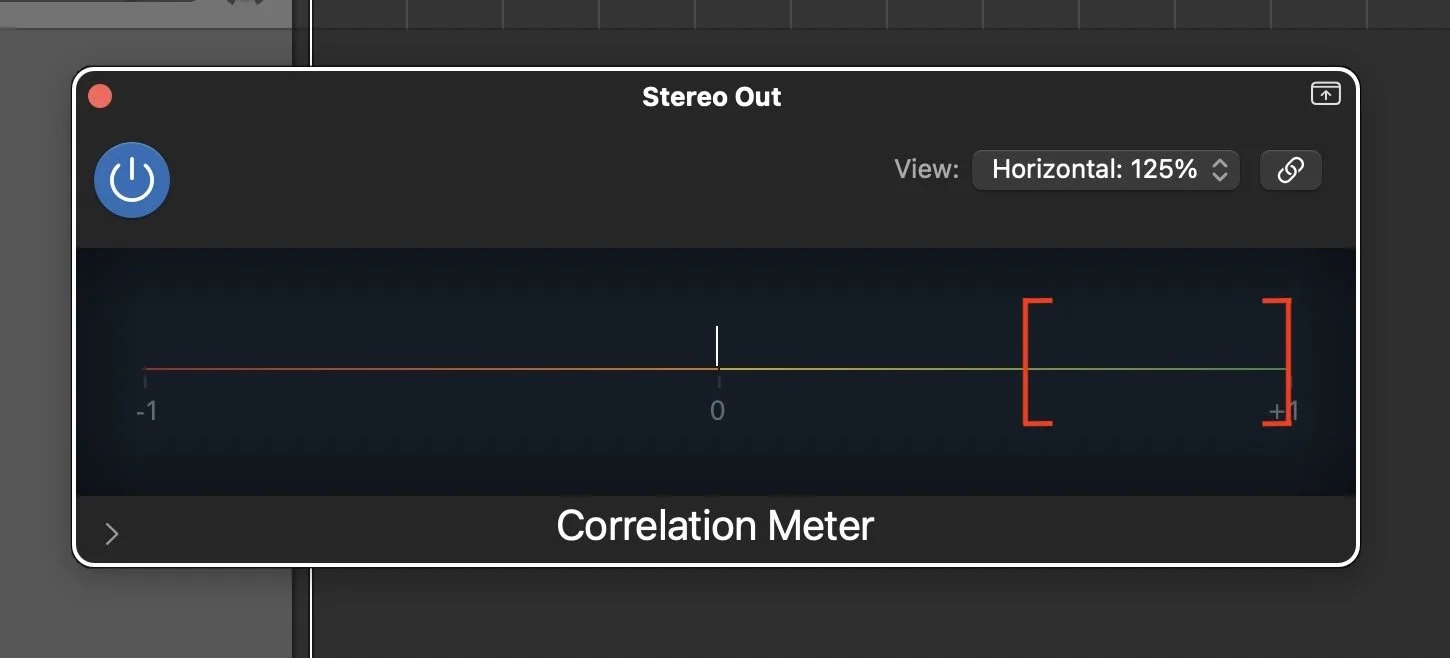
The phase correlation meter inside Logic Pro. Keep your mix in the bracketed area.
Phase considerations in digital audio production
In the digital world, there’s not as many limitations on phase: what you can hear is generally what you can do. What you can do is often different than what you should do, however.
I wouldn’t make your mix too wide by using a lot of very hard pans, which is a particularly easy mistake to make when mixing in headphones. As you pan your mix wider, it also gets thinner sounding, so try to keep that deep, three dimensional sound in your work by always anchoring sounds a little bit closer to the center, especially in the bass area.
A rule of thumb I like to use when panning: keep everything between 9-3 on the dial to start, then adjust from there. I like to save any pans more extreme than 9-3 for special effects and auxiliary parts, mostly in the mid/high frequencies. Don’t hard pan your bass instruments: it can be very unsettling to the listener, and in a vinyl production doing this can cause some serious issues.
Phase considerations in vinyl production
In the analog world, phase and panning specifications are more strict and the consequences for breaking them higher. If you pan your sounds too wide inside a vinyl production, you can cause the needle to skip right out of the record groove during playback. Especially if there are loud, low frequency instruments panned hard into the side channels (like a kick drum or a bass guitar).
In vinyl record production, we generally like to see anything below 300 Hz locked straight down the center of a mix. Nothing in the side channels below 300 Hz whenever possible will result in the clearest, most three dimensional sound on your vinyl record.
In part 3 of this series, we’ll compare how loudness and the high frequencies work between digital and analog mediums.